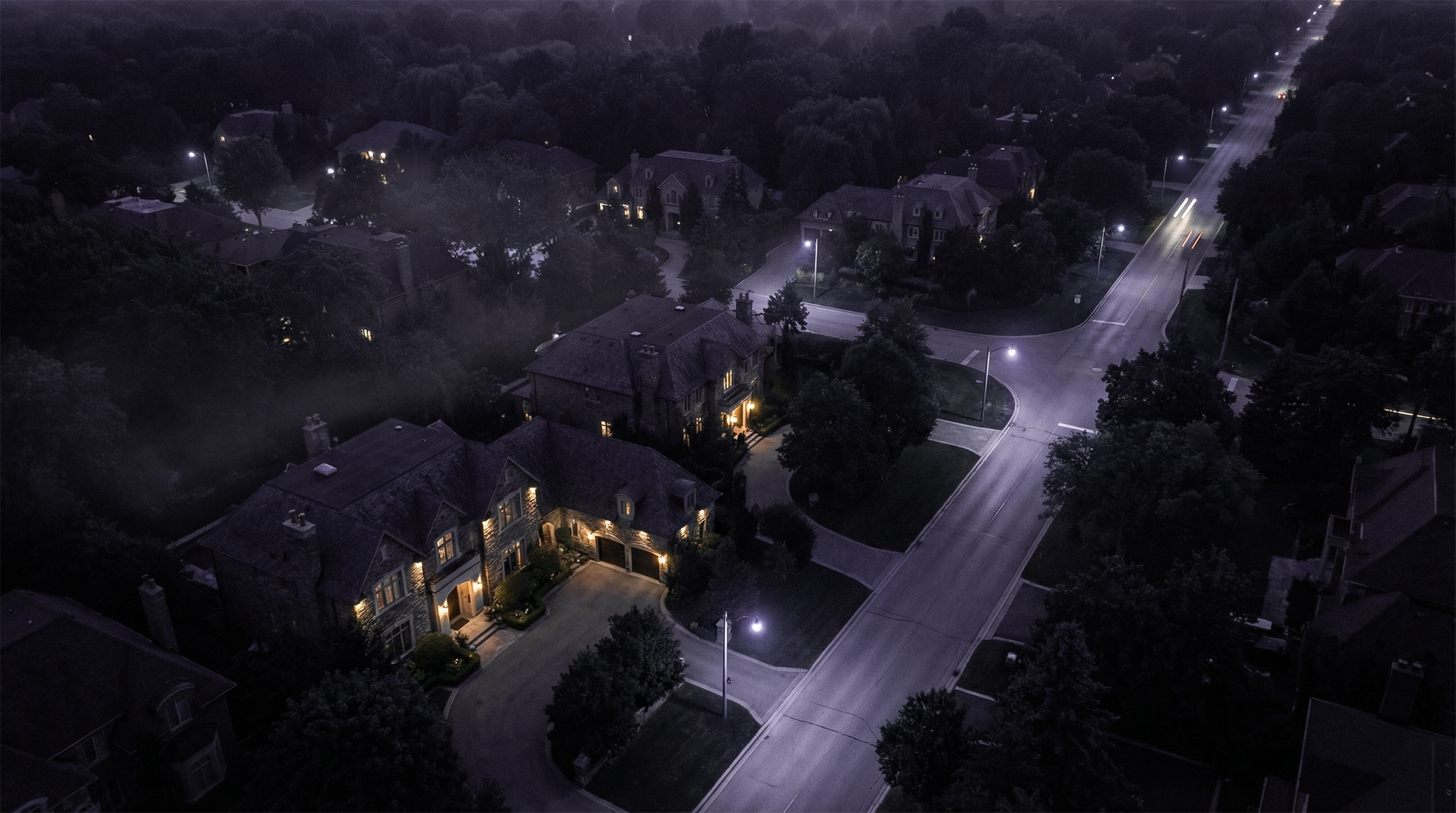
Toronto Police Service data shows that some of the city's most expensive neighbourhoods - Bridle Path, Rosedale, and St. Andrew-Windfields - recorded break-in rates more than double the citywide average in 2025. High property value is not a security posture.
February 23, 2026
There is a persistent and dangerous assumption among residents of Toronto's premium neighbourhoods: that a high-value address is, by definition, a safe one. The data from the Toronto Police Service tells a different story.
According to the TPS Neighbourhood Crime Rates dataset, Toronto recorded a citywide break-and-enter rate of 189.5 incidents per 100,000 people in 2025. While the overall number declined 13.6% from the prior year, the geographic pattern of where these incidents occurred is more telling than the aggregate trend.
The neighbourhoods with the highest break-in rates in 2025 were not uniformly high-density or economically distressed areas. Several of them ranked among the city's most affluent addresses.
Bridle Path-Sunnybrook-York Mills, home to some of Canada's most expensive residential estates (average home price exceeding $3.8 million), recorded a break-in rate more than double the city average. Rosedale-Moore Park ranked third citywide for break-in rate, despite relatively low incidence across nearly every other crime category. St. Andrew-Windfields, another enclave of large, high-value properties in North York, ranked among the top ten.
The common thread is not disorder. It is value.
Professional criminal networks operating in Toronto increasingly conduct residential break-ins as deliberate, premeditated operations - not opportunistic events. Intelligence is gathered in advance. Entry points, security gaps, and occupancy patterns are assessed before a target is approached.
High-net-worth properties are attractive for specific reasons. Asset density: luxury watches, jewellery, art, cash, and portable electronics represent concentrated, liquidable value in a single location. Lower occupancy during travel: affluent households often have predictable seasonal or travel patterns that organized groups track and exploit. Physical separation: larger lot sizes and estate-style properties, while offering privacy, also limit natural surveillance from neighbours. Reduced police proximity: lower-density premium neighbourhoods typically have lower police patrol frequency per block than commercial or mixed-use areas.
Toronto ranked 6th globally for overall urban safety in the 2024 EIU Safe Cities Index. But this also creates a kind of false security at the individual level. A city being statistically safe in aggregate is a poor predictor of risk at the household level in a targeted category.
Toronto's property crime rate, as reported by the Fraser Institute, is 40% higher than New York City's - a data point that sits uncomfortably alongside the city's safety reputation. For residents of Bridle Path, Rosedale, Forest Hill, or Lawrence Park, the relevant question is not whether Toronto is safe. It is whether their specific household, with its specific asset profile and security posture, is adequately protected.
Standard residential security - a monitored alarm, perimeter cameras, perhaps a smart lock - addresses a portion of the risk. It provides detection and post-incident documentation. It does not provide deterrence at scale, and it does not close the gap created by delayed emergency response times.
When a break-in is executed by professionals who complete their work in under four minutes, the interval between alarm trigger and police arrival is irrelevant.
Effective residential security at this level requires a different architecture: visible deterrence that signals active monitoring and rapid physical response capability, behavioural detection before a perimeter is breached, coordinated neighbourhood-level oversight so that threat patterns are identified at the street level, and rapid human response with the training and mandate to intervene.
This is precisely the gap that the OZINT Overwatch programme was designed to close. Not as a replacement for existing systems, but as a coherent layer of professional-grade protection built specifically for high-value residential environments in Toronto.


